
Review · ROME
Rome Morning Vespa Sidecar Tour in Rome with Cappuccino
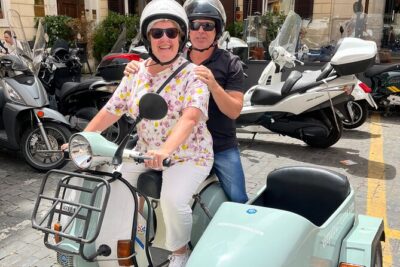
Rome is made for a Vespa. The sidecar tour lets you cover a remarkable stretch of the city in three hours, from the Trevi Fountain and Pantheon to St. Peter’s Square, the Colosseum, and the Jewish Ghetto. You sit back while a professional driver handles traffic and a guide, often someone like Claudio, Matteo, Luca, Alessio, or Barbara, explains what you are seeing through a headset.
I like the small-group feel, with a maximum of 12 people, and the way the tour mixes famous monuments with ordinary Roman streets and neighborhoods. I also like the practical extras: a proper cappuccino and cornetto, a stop at the Pantheon with entry included, photo breaks, helmets, and clear audio commentary. The main drawback is that this is a sightseeing sampler, not a series of long museum visits. You will see a lot, but most stops are brief.
Key points before you book
- Twelve major sights in three hours: The route covers Rome’s grand landmarks, historic squares, panoramic hills, and local neighborhoods.
- You do not drive: A professional driver navigates narrow streets and traffic while you ride in the sidecar or behind the driver.
- Pantheon entry is included: This is the only listed interior admission, giving you time to see the ancient dome and oculus.
- Breakfast is part of the morning: You receive a traditional cappuccino and cornetto, with water also provided.
- Seats may be shared: A Vespa carries two people, one in the sidecar and one behind the driver, with seat changes possible during stops.
- Weather matters: The tour needs good weather, and pregnancy is not permitted.
Why a Vespa sidecar works so well in Rome
Rome is spread across hills, ruins, grand avenues, tiny lanes, and neighborhoods that do not connect neatly on foot. A walking tour can show you one district well, but it cannot easily take you from the Quirinal Palace to Janiculum Hill, then across to the Colosseum and Santa Maria Maggiore before lunch.
A bus can cover the distance, but it often leaves you looking through glass or waiting in traffic. The Vespa gives you a closer view. You feel the changes in the city as you move from monumental Rome to quieter lanes and trattoria-lined streets. You also get near many sights without spending time finding each one yourself.
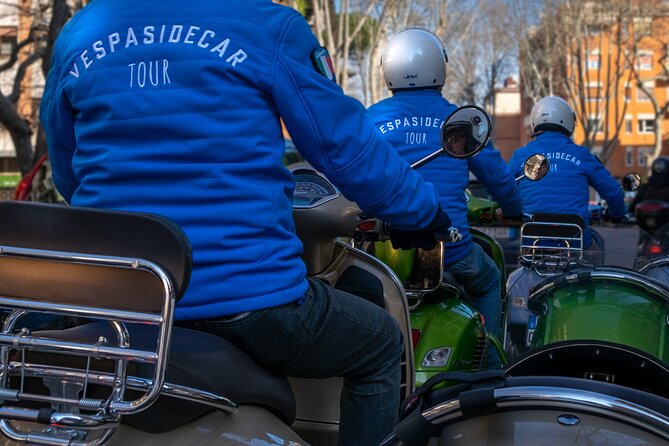
The arrangement is comfortable for people who want to see Rome without driving. The drivers handle the road, parking, and navigation. Your guide speaks through headsets, so you can hear the commentary while moving and at stops. Sterilized disposable helmet covers are supplied under the CE-approved helmets.
This is not a private tour by default. The maximum group size is 12, and a Vespa accommodates two people. If you book one seat, you may share the vehicle with another person. If your party has an odd number, someone will alternate between the sidecar and the seat behind the driver at stops. Seat changes are possible, so tell the team if the sidecar is especially important to you.
More Vespa Sidecar Tours in Rome:
- Vespa Sidecar Tour By Night with Pickup
★ 5.0 · 1,803 reviews - Rome: Highlights Vespa Sidecar Tour with Coffee and Gelato
★ 4.9 · 747 reviews - Rome Afternoon Sightseeing Vespa Sidecar Tour with Gourmet Gelato
★ 5.0 · 692 reviews
Starting at Piazza della Repubblica at 9 a.m.
The meeting point is at Piazza della Repubblica, 41, near one of Rome’s broadest nineteenth-century squares. This is a useful start because the square reflects the major rebuilding of Rome after Italy made the city its capital.
The Fontana delle Naiadi sits in the middle of the roundabout. Around it are imposing buildings, while one side has the remains of the Baths of Diocletian, giving the opening stop a quick lesson in Rome’s habit of placing ancient fragments beside modern city planning.
You spend about 10 minutes here. That is enough for an orientation and a few photographs, but not enough for a detailed visit to the baths or nearby churches. Think of the stop as the opening page, not a full chapter.
The Quirinal Hill and Trevi Fountain
The Vespa then climbs toward the Palazzo del Quirinale, one of the official residences of Italy’s president. The building has also served 30 popes, four kings of Italy, and 12 presidents. Its position on the Quirinal Hill gives your guide a chance to explain how Rome’s political and religious power shifted over the centuries.
The stop at the palace is brief, around five minutes. You will not tour the interior, but the exterior and hilltop setting make it a useful piece of context before the route drops into the crowded center.
At the Trevi Fountain, the tour allows about 30 minutes, one of the longer outdoor stops. This is enough time to study the marble figures, take photographs, and toss in a coin if that is your tradition. The fountain measures about 20 meters wide and 26 meters high, making it even more impressive when you approach it through the surrounding lanes.
The name Trevi comes from Tre Vie, or three streets, because the fountain sits where three roads meet. Its water comes from the Aqua Virgo aqueduct, whose ancient route ended here. The present fountain was completed in 1762 after work by Nicola Salvi and Giuseppe Pannini.
The practical advantage of arriving by Vespa is simple: you are not spending your morning working out how to link the fountain with the next sight. The practical limitation is equally simple: Trevi can be crowded, and a guided stop cannot remove the crowds. Keep your valuables secure and stay aware of the group.
Inside the Pantheon with cappuccino and cornetto
The Pantheon is the tour’s main interior visit, and admission is included. Built as a temple and completed in 126 AD, it is the best-preserved major building from ancient Rome. Its defining feature is the oculus, the open round window at the top of the dome that provides the main source of natural light.
You have about 30 minutes here. That gives you time to look up at the dome, understand the scale of the interior, and listen to the guide’s explanation. It is a much more meaningful visit than simply stopping outside for a photograph.
The morning also includes a traditional cappuccino and cornetto. This is not just a quick drink handed over while standing beside the scooters. The breakfast break gives you a chance to sit, rest, and reset before the second half of the ride. A cornetto is the Italian answer to a breakfast pastry, often plain or filled, and it is a fitting Roman pause.
Fresh water is also provided. If you have dietary requirements, include them when booking. The supplied information does not specify the café or the available pastry fillings, so anyone with strict dietary needs should make those needs clear in advance.
More Vespa Tours in Rome:
- Rome: Explore the City by Vespa with an Optional Photoshoot
★ 5.0 · 1,103 reviews - Rome Vespa Scooter Tour with Professional Photographer
★ 5.0 · 857 reviews - Rome: Vespa Ride with Pictures and Sweet Tastings
★ 5.0 · 723 reviews - Rome: Vespa Tour with Photo services Small‑Group Highlights
★ 5.0 · 483 reviews
Piazza Navona and St. Peter’s Square
Piazza Navona occupies the site of an ancient Roman stadium. Its long shape still hints at that earlier use, while the present square is framed by Baroque architecture and fountains. Bernini’s Fountain of the Four Rivers is the star feature, with its sculpted figures representing four major rivers.
The square is a good example of Rome’s layered character. An ancient sporting site became a Baroque public space, and today it remains one of the city’s best places for people-watching. The route treats it as a sightseeing stop rather than a long café visit, so keep your camera ready.
From there, the tour reaches St. Peter’s Square in Vatican City. Bernini designed the great oval colonnade in the seventeenth century, and the space can hold more than 300,000 people. The view toward St. Peter’s Basilica is one of Rome’s essential city scenes.
This tour does not list entry to St. Peter’s Basilica or the Vatican Museums. You see the square from the outside. That is useful if you have a separate Vatican reservation, since it lets you understand the setting without using up time intended for a full Vatican visit.
Janiculum Hill for the best wide view
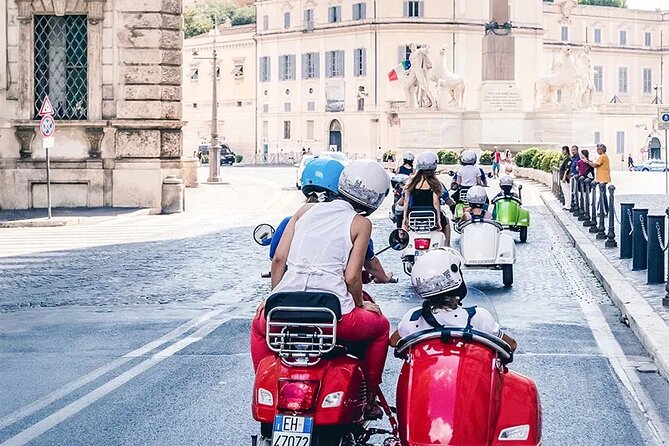
Janiculum Hill, or Gianicolo, sits just beyond ancient Rome and is often called the city’s eighth hill. The Terrazza del Gianicolo provides a broad view over Rome’s rooftops and domes. After several close-up monuments, this pause gives you room to see how the city fits together.
The stop lasts about 15 minutes. You will have time for photographs and a quick look around, but this is not a long walk on the hill. The area also carries strong links to the defense of Rome. Giuseppe Garibaldi and other figures connected with the city’s nineteenth-century struggles are commemorated along the paths.
I consider this one of the route’s most useful stops. The Trevi Fountain and Pantheon show detail. Janiculum Hill shows scale. If the weather is clear, you will get the kind of view that helps you make sense of the city for the rest of your stay.
Trastevere lanes and the Jewish Ghetto
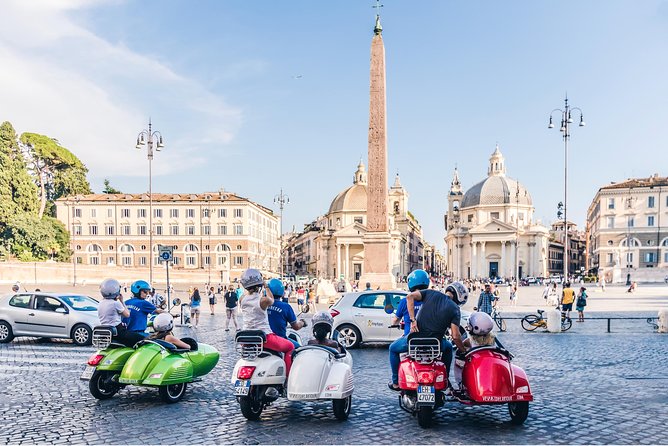
The route continues through Rome’s more local-looking streets, including the bohemian neighborhood of Trastevere and the Jewish Ghetto. You pass typical trattorias, narrow lanes, and corners that feel less arranged for sightseeing than the big squares.
This is where the sidecar earns its price. You can move through streets that are awkward to connect on foot, while the guide points out landmarks and gives the neighborhood some context. You are not stopping at every church or restaurant, so note places that catch your eye and return later for a meal or a slower walk.
The Jewish Ghetto is another reminder that Rome cannot be reduced to imperial ruins and Baroque fountains. It has its own history, food traditions, and street pattern. The tour gives you an introduction, not a full neighborhood study, but it may help you choose where to spend an evening.
Piazza Venezia, the Colosseum, and Santa Maria Maggiore
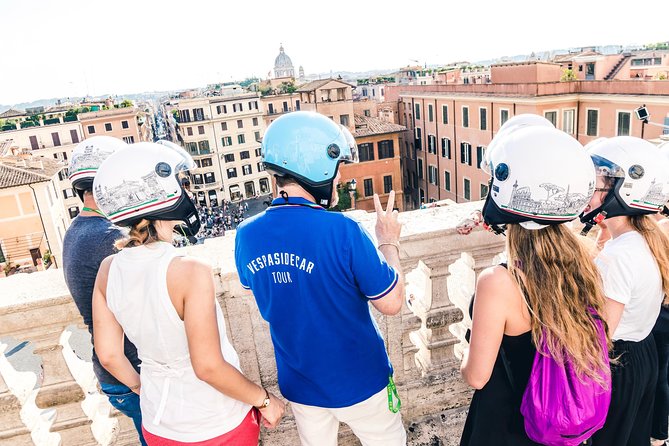
At Piazza Venezia, you see the Monumento Nazionale a Vittorio Emanuele II, also called the Altare della Patria. The white monument honors Victor Emmanuel II, the first king of unified Italy, and was inaugurated in 1911. It also contains the Tomb of the Unknown Soldier, guarded beside an eternal flame.
Some people find the monument grand; others find it too large and bright against the older city. Either way, it is impossible to miss, and the square is a useful place to discuss Italian unification and the way modern national symbols were placed in the ancient center.
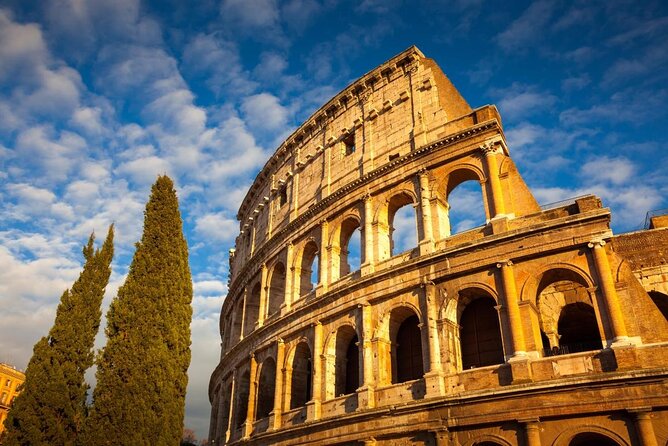
The Colosseum follows, with its immense outer walls and nearly 2,000 years of history. It was known in antiquity as the Flavian Amphitheatre and remains Rome’s most recognizable monument. The tour stops for views and photographs, but entry to the Colosseum is not included.
That distinction matters. If you want to tour the arena and underground areas, book a separate timed visit. This morning ride is better for getting your bearings and seeing how the Colosseum relates to the surrounding ruins, roads, and hills.
The route also includes the Basilica of Santa Maria Maggiore, one of Rome’s four major basilicas and the largest of the churches dedicated to the Virgin Mary in the city. The supplied schedule does not give a separate time or interior admission for this stop, so expect it to be part of the drive-by and sightseeing circuit rather than a full church visit.
Guide commentary, drivers, and the human side of the ride
The guide narrates throughout the tour, and headsets make the commentary easier to follow than shouted explanations in traffic. Names associated with the experience include Claudio, Matteo, Luca, Alessio, and Barbara, while drivers have included Manuel, Alessandro, and Massimo. Your assigned team may be different.
The strongest part of the operation is the division of roles. The driver concentrates on the road, while the guide concentrates on Rome’s stories. This is especially helpful on narrow lanes and busy streets, where trying to steer, watch traffic, and listen to history would be a poor plan.
The personal touches can vary, but the service has included help with family photographs, blankets, and even hot-water bottles on colder mornings. Those details are not guaranteed, yet they show why the experience can feel more personal than a standard large coach tour.
At the same time, you should be comfortable with motion, traffic noise, and open-air riding. This is not a silent sightseeing vehicle. It is a lively way to move through the city, and the weather can affect the experience.
Is $163.26 a fair price?
At $163.26 per person, this is not Rome’s cheapest sightseeing option. You are paying for three hours of transport, several professional drivers, a licensed guide, headsets, helmets, breakfast, and Pantheon admission. You are also paying for the ability to cover much more ground than you could comfortably walk in one morning.
The value is strongest on a first visit, especially if you want to see the city’s major landmarks before choosing where to return. It can also suit a family with a teenager who would rather ride than join another long walking tour. The route provides a quick sense of Rome’s shape and gives you a list of places to explore more slowly later.
The value is weaker if your priority is entering monuments. Only the Pantheon entry is included. You do not get Colosseum, Vatican Museums, or St. Peter’s Basilica admission. A person who prefers long museum visits may get more from a focused walking tour and separate tickets.
The price also makes more sense if you value comfort. You avoid parking problems, route planning, and much of the legwork. For a compact morning that combines transportation, commentary, landmarks, breakfast, and a panoramic stop, the cost is reasonable for the right kind of visitor.
Who should book this Rome sidecar tour?
I would choose this tour for a first or second visit, for anyone with limited time, and for people who want a fun overview before settling into slower sightseeing. It works well for families with children at least five years old, provided the child is accompanied by an adult and meets the height rules.
Children must be at least five years old. A child taller than 150 centimeters may sit behind the driver. Otherwise, the child must use the sidecar. The sidecar limit is 110 kilograms and 1.90 meters in height. The rear saddle limit is 118 kilograms.
The tour is not permitted for pregnant travelers. Service animals are allowed, and most people can participate, but the vehicle format may not suit anyone who dislikes riding in traffic or needs more space than the stated limits allow.
Book it if you want Rome to move past your eyes in a fast, memorable stream of fountains, domes, ruins, lanes, and hilltop views. Skip it if you want a quiet, detailed study of one district or several full museum interiors. For many visitors, this is best used near the start of a Rome stay, when the ride can help you decide where to return on foot.
FAQ
Where does the Rome Vespa sidecar tour start?
It starts at Piazza della Repubblica, 41, 00185 Rome, Italy.
What time does the tour begin?
The scheduled start time is 9:00 a.m.
How long does the experience last?
The tour lasts approximately three hours and ends back at the meeting point.
Is breakfast included?
Yes. The tour includes a traditional cappuccino and cornetto. Water is also provided.
Is entry to the Pantheon included?
Yes. The Pantheon entrance fee is included.
Does the tour include entry to the Colosseum or Vatican?
No. The included entrance is for the Pantheon. The route includes sightseeing at the Colosseum and St. Peter’s Square, but no Colosseum or Vatican entry is listed.
How many people can join the tour?
The maximum group size is 12 people.
Can one Vespa carry two people?
Yes. Each Vespa can accommodate two people, with one person in the sidecar and one behind the driver. Seats may be changed during stops. With an odd-numbered booking, passengers accept alternating seats.
What happens if the weather is bad?
The experience requires good weather. If it is canceled because of poor weather, you will be offered another date or a full refund. You can also cancel for a full refund up to 24 hours before the start time.
More early starts around Rome
- Morning Vespa Sidecar Tour with Cappuccino
★ 5.0 · 3 reviews - Morning Saigon Unseen Adventure Scooter with Ao Dai Riders Option
★ 5.0 · 646 reviews - Saigon Morning City Historical Scooter Tour w Ao Dai Rider option
★ 5.0 · 349 reviews - Good Morning Saigon Tour by Motorbike and Scooter
★ 5.0 · 290 reviews
Freshly added rides around Rome
- Vespa Voyage: Scenic Routes of Rome★ 5.0 · 41 reviews
- Vespa – Wine and Photography service in Rome★ 5.0 · 32 reviews
- Vespa tour with Professional Photoshoot★ 4.8 · 22 reviews
- Rome: Vespa Tour with Gelato and Photos★ 4.9 · 7 reviews
- Vespa Tour with Professional Photographer★ 4.9 · 9 reviews
- Vespa Tour – Explore Ancient Rome★ 5.0 · 5 reviews
- Vespa Sidecar Tour: Highlights of Rome★ 4.7 · 10 reviews
- Vespa Sidecar Tour : Rome by Night★ 4.1 · 7 reviews
Rome Scooter Tours, compared.
Rome: Explore the City by Vespa with an Optional Photoshoot
Read our review →
Rome Vespa Scooter Tour with Professional Photographer
Read our review →
Rome: Highlights Vespa Sidecar Tour with Coffee and Gelato
Read our review →
Rome: Vespa Ride with Pictures and Sweet Tastings
Read our review →
Rome Afternoon Sightseeing Vespa Sidecar Tour with Gourmet Gelato
Read our review →
Rome: Vespa Tour with Photo services Small‑Group Highlights
Read our review →
Vespa Sidecar Tour In Rome with Pickup, Drop-off, Gelato included
Read our review →Other lists with this scooter ride