
Review · BERLIN
Private Guide Up to Group 6 – ONE Rickshaw, (E)Bikes, E-Scooters
Berlin is unusually well suited to a tour like this. Its major sights are spread across broad boulevards and open squares, yet many are close enough to link by bike or rickshaw. You can cover a lot of central Berlin in three hours without spending the day on foot.
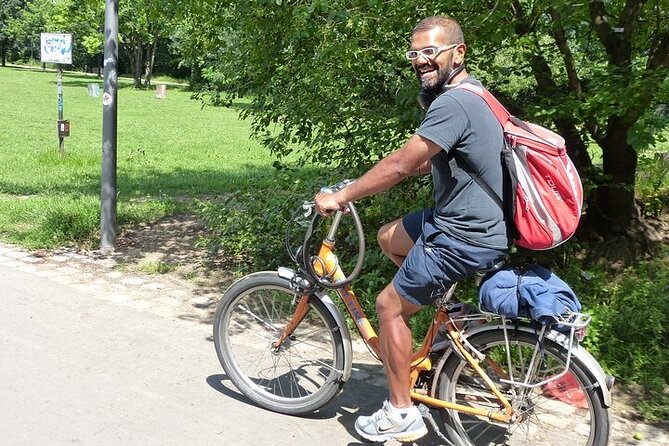
I especially like the choice of vehicles and the way the group can stay together while using different options. I also like the personal style of guide Levi, who uses humor, speaks Dutch, welcomes questions, and includes children in the stories. The main drawback is the price: $465.43 for a group of up to six is fair for a private outing, but expensive for one or two people.
Key points to know
- Pick your pace and vehicle: Use regular bikes, e-bikes, e-scooters, or a rickshaw.
- A strong first-day overview: The route links Berlin’s royal, Nazi, Cold War, and reunification sites.
- Private for your group: Only your party takes part, with a maximum booking size of six.
- Useful for limited mobility: The rickshaw brings you close to monuments and requires only a few steps to enter.
- Guide-led storytelling: Levi adds humor, answers questions, and can conduct the tour in Dutch.
- Plan for a history-heavy outing: The Holocaust Memorial, Führerbunker site, and Topography of Terror are serious stops.
A flexible way to see central Berlin
This is not a standard coach tour where you watch the city through glass. You move through Berlin at street level, stopping in squares, beside monuments, and near sites tied to some of Europe’s most important events.
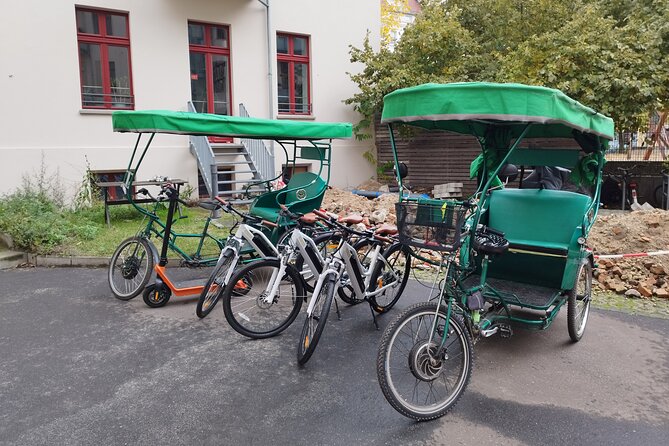
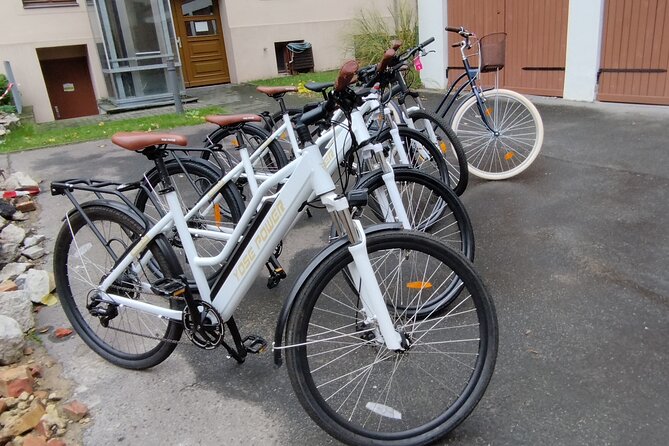
Your group can choose from regular bicycles, e-bikes, e-scooters, or one rickshaw. The available setup lists two regular bikes, three e-bikes, and one rickshaw that can carry up to seven people, while the booking itself is priced for a private group of up to six. Confirm the exact vehicle arrangement when you book, especially if your party needs several bikes or the rickshaw.
The tour lasts about three hours. That is enough time for a useful orientation, but not enough for long museum visits or detailed exploration at every stop. Think of it as a moving introduction to Berlin, with short pauses for explanations and photographs.
I like this format for a first day in the city. You get a mental map quickly, then you can return later to the places that deserve more time.
More Electric Scooter Tours in Germany:
- 2 Hours Hamburg E-scooter Tour
★ 4.2 · 103 reviews - Cologne: Guided E-Scooter Tour
★ 4.7 · 90 reviews - Berlin: Thrilling E-Scooter Adventure Tour
★ 4.5 · 71 reviews
Meeting the city at Alexanderplatz
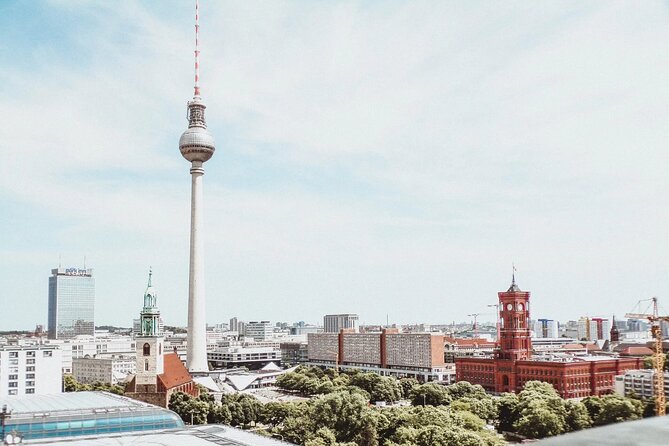
The usual starting point is near Berlin’s TV Tower, although the stated meeting point is Weinbergsweg 6 in Berlin. The TV Tower rises 368 meters above Alexanderplatz and is one of the city’s clearest reference points.
You do not enter the tower on this tour. Instead, it gives you a useful opening view of modern Berlin and its changing city center. The tower’s silver sphere and tall shaft reflect the former East Berlin of the German Democratic Republic, while the surrounding area shows the city’s newer commercial side.
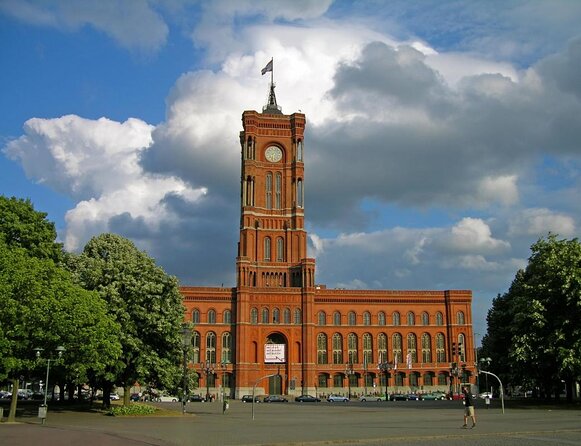
From here, the route moves toward Berlin City Hall, known as the Rotes Rathaus. Its red-brick facade and central political role make it a good stop for understanding how Berlin functions as a capital city. The guide can connect the building to the city’s government and development before moving you onward.
The palace, Museum Island, and Unter den Linden
The Berlin City Palace, or Stadtschloss, is now home to the Humboldt Forum. The building carries an unusual story. A royal residence dating back to the fifteenth century was destroyed during the Second World War, later removed under East German rule, and eventually rebuilt with a Baroque exterior and modern interior spaces.
You get about 15 minutes here, with no admission charge included or required for the outdoor stop. The value is the explanation, since the building can look like an old palace even though much of what you see is part of a modern reconstruction.
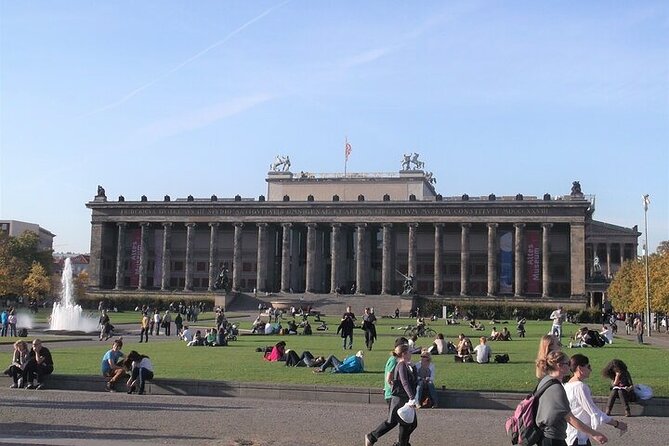
Next comes Museum Island, a UNESCO World Heritage site with several major museums. You spend about 20 minutes in the area. That is enough to see the setting and hear why Berlin gathered so many cultural institutions along the Spree, but not enough to visit the collections.
If you want to enter the museums, plan a separate visit. This tour helps you decide which one deserves your time later.
The route then follows Unter den Linden, Berlin’s grand central boulevard. Its buildings reflect several eras, from Baroque and Neoclassical design to modern additions. You may see the State Library, Kronprinzenpalais, and the approach toward Brandenburg Gate.
The stop lasts about 10 minutes. This is a place where the vehicle makes a real difference. On foot, the boulevard can feel long. By bike or rickshaw, you can take in its scale without using up your best sightseeing energy.
Bebelplatz and the warning beneath the pavement
Bebelplatz is one of the tour’s most important short stops. In May 1933, books condemned by the Nazi regime were burned here in a public display of censorship and political control.
A glass panel in the square lets you look down into an empty library designed by artist Micha Ullman. The shelves are intentionally bare. It is a quiet memorial, and the short stop can feel more powerful than a long lecture.
Allow about 10 minutes. The guide’s role matters here. A quick photograph does not explain why the square is important, but a clear account of the book burning gives the site its meaning.
More Private Scooter Tours in Germany:
- Berlin: 3-H VIP Private E-Scooter Highlights Tour
★ 4.5 · 4 reviews - Private Up to 12 Guests-ONE RICKSHAW, E-Bikes, E-Scooters
★ 5.0 · 2 reviews - Private Ho Chi Minh Sightseeing and Food Tour by Scooter
★ 5.0 · 258 reviews - The BEST Private Amalfi Coast Vespa Tour
★ 5.0 · 247 reviews
Gendarmenmarkt and the architecture of old Berlin
Gendarmenmarkt is one of central Berlin’s most handsome squares. The Konzerthaus sits between the French Cathedral and the German Cathedral, creating a balanced Neoclassical scene.
The French Cathedral recalls Berlin’s Huguenot community. The German Cathedral now includes historical exhibits. The Konzerthaus remains a major concert venue.
You stop for about 10 minutes, which is enough to appreciate the composition of the square and take pictures. The drawback is that this is another exterior-focused visit. If you want to see the interiors or attend a performance, you will need more time on your own.
Still, this stop gives the route a welcome change of tone. After the difficult subjects at Bebelplatz and later sites, Gendarmenmarkt offers art, music, architecture, and religious history in one compact setting.
Checkpoint Charlie and the Cold War city
Checkpoint Charlie is one of Berlin’s best-known Cold War locations. It once marked a crossing between the American and Soviet sectors, and its name comes from the NATO phonetic alphabet.
The guardhouse you see today is a replica, and actors may be present in U.S. military police uniforms. That can feel theatrical, so your guide’s explanation is more useful than the photo opportunity alone.
The stop lasts about 15 minutes. Levi can place the crossing in the larger story of a divided Berlin, where a city street became part of the Iron Curtain. The nearby Mauermuseum, now associated with the site, requires separate time if you want to visit.
This stop is often crowded and commercial in feel. That is worth knowing before you arrive. The historical importance is real, but the current setting is not preserved as a quiet memorial.
The Topography of Terror and the Führerbunker site
The Topography of Terror presents the crimes of the Gestapo and SS from the site of their former headquarters. Exhibits, documents, and surviving traces of the buildings explain how Nazi institutions organized persecution and terror.
You spend about 20 minutes here. That is a short visit for a serious museum, so treat it as an introduction rather than a full museum experience. If this subject matters deeply to you, return later and allow more time.
The route also stops near the former Führerbunker. Adolf Hitler spent the final months of the Second World War in this underground complex beneath the Reich Chancellery garden. The site is now beneath a parking area, with no visible bunker structure.
That lack of a grand marker is deliberate. The remains were largely removed after the war to prevent the place from becoming a shrine for neo-Nazis. You get about 10 minutes here, mostly to understand the location and the decision not to turn it into a monument.
This is a brief stop, but it helps explain the final days of Nazi rule. Do not expect dramatic ruins or an underground visit.
The Holocaust Memorial and Brandenburg Gate
The Memorial to the Murdered Jews of Europe covers a sloping field with 2,711 concrete blocks of different heights. You can walk between them, with the ground dropping and the blocks rising around you.
The design creates disorientation and discomfort. That physical reaction is part of the experience. You do not need a long explanation to see that the memorial is about loss, scale, and the removal of individual identity, but the guide can provide essential context.
The stop is listed at about 10 minutes. I would treat that as the minimum. You may want more time to walk through the field quietly, especially if you are visiting with older children who can engage with the subject respectfully.
The final major stop is Brandenburg Gate. Completed in 1791, this Neoclassical arch has seen Prussian rule, Nazi spectacle, wartime destruction, Cold War division, and German reunification.
It once marked the beginning of Unter den Linden. Today it is one of Berlin’s strongest symbols of a city that was divided and later reunited. The tour allows about 10 minutes, enough for photographs and a final explanation.
Because Brandenburg Gate is often the image people associate most with Berlin, ending here gives the route a satisfying finish. You have moved through monarchy, dictatorship, division, and reunification in a single loop.
What the price means for your group
The cost is $465.43 per group of up to six, not per person. For six people, that works out to roughly $78 per person. For two people, it becomes more than $232 each, which is hard to justify unless you value privacy, personal pacing, and the vehicle choice.
The price includes the private guide, selected vehicle arrangement, bottled water, WiFi on board, and an air-conditioned vehicle. Lunch is not included. The most valuable part is not the water or WiFi. It is having one guide shape the route around your group rather than joining a large public tour.
A private booking also makes questions easier. Levi’s style is informal and humorous, and he takes time with questions. That matters in Berlin, where a short fact about a building can lead to a much larger question about dictatorship, division, or reconstruction.
For a family or work group of four to six, the value is much better. You can split the cost, avoid coordinating several separate bookings, and keep the group together even if some people bike while others ride in the rickshaw.
Accessibility, comfort, and practical limits
The rickshaw is the strongest feature for anyone with limited mobility. You enter it in only a few steps, and the vehicle can stop close to monuments for photographs. You do not need to walk between every sight.
The supplied details say most people can participate, but they do not provide a specific weight limit, wheelchair transfer policy, or exact rickshaw capacity for every booking. Contact the provider before paying if you need a particular accessibility arrangement.
The route is also useful for families. One direct account describes Levi involving children in the stories and bringing water and pretzels during a longer ride. Pretzels are not listed as a standard inclusion, so do not count on them, but the example suggests that the guide is attentive to family groups.
Dutch speakers have another reason to consider this tour. Levi can conduct the experience in Dutch, which may make complex subjects easier to discuss. English language service is not specifically stated in the supplied details, so confirm your preferred language when booking.
The start and end are both tied to the meeting point, and public transportation is nearby. Confirmation arrives at booking. Free cancellation is available up to 24 hours before the start time. Inside that window, the payment is not refunded, and changes are not accepted.
Who should book this Berlin tour?
I would choose this tour for a group that wants a broad first look at central Berlin without committing to a long walking route. It works especially well for families, small work groups, Dutch-speaking parties, and people who find a full day on foot difficult.
It is also a good match if you want a guide who tells stories with humor rather than delivering a formal lecture. Levi’s personal approach appears central to the experience, so request him by name if possible.
I would not choose it for a serious museum visit, a deep architectural study, or a slow exploration of each memorial. The stops are short, and several sites deserve a return visit. The tour is best understood as a smart orientation with human-scale transport.
Should you book it?
Book this private Berlin tour if your group has four to six people, wants flexibility, and likes the idea of moving between major sights without wearing out your feet. The rickshaw makes it unusually practical for less mobile visitors, while the bikes and e-scooters keep the outing active for others.
Think twice if you are alone or traveling as a couple. The private-group price becomes high, and a public walking or cycling tour may offer better value. Also prepare for serious material. Bebelplatz, the Topography of Terror, the Führerbunker site, and the Holocaust Memorial are not light sightseeing stops.
For the right group, this is a lively, practical way to get your bearings fast, hear Berlin explained by a personable guide, and mark the places you want to explore at greater length.
FAQ
How long does the Berlin private tour last?
The tour lasts approximately three hours.
How many people can join the private tour?
The booking is for a private group of up to six people. The vehicle details also list one rickshaw that can carry up to seven people, so confirm the exact arrangement with the provider if your group size or vehicle needs are unusual.
Which vehicles can I choose?
You can choose regular bikes, e-bikes, e-scooters, or a rickshaw. The listed equipment includes two bikes, three e-bikes, and one rickshaw.
Where does the tour start and finish?
The stated meeting point is Weinbergsweg 6, 10119 Berlin, Germany. The tour ends back at the meeting point.
Is the tour suitable for people with limited mobility?
Yes. The rickshaw is intended to help less mobile people, requires only a few steps to enter, and can stop close to monuments for photographs. Contact the provider in advance about any specific accessibility needs.
Is lunch included?
No. Lunch is not included. Bottled water is included.
Can I cancel for a full refund?
Yes, if you cancel at least 24 hours before the experience start time. Cancellations or changes made within 24 hours are not refunded or accepted.
Freshly added rides around Germany
- 2 hour Sights Guided E-Scooter Tour in Munich★ 4.0 · 6 reviews
- 2 Hours Guided Hamburg E-Scooter Tour★ 3.5 · 10 reviews
- Private Up to 12 Guests-ONE RICKSHAW, E-Bikes, E-Scooters★ 5.0 · 2 reviews
- 3-H E-scooter Sightseeing Tours in Berlin★ 4.5 · 5 reviews
- 2 Hours E-Scooter Tour★ 5.0 · 2 reviews
- 3-H Munich: Top Sights E-Scooter Tour with Local Guide★ 3.8 · 5 reviews
- Munich: Top Sights Guided E-Scooter Tour★ 4.1 · 35 reviews
- Berlin: 3-Hour Guided Small Group Fat Tire E-Scooter Tour★ 4.6 · 23 reviews
Berlin Scooter Tours, compared.
Berlin: 3-Hour Guided Small Group Fat Tire E-Scooter Tour
Read our review →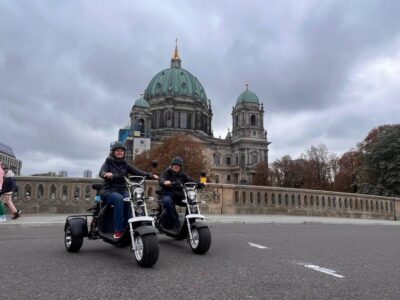
Berlin City: 2 Hour Guided Fat Tire E-Scooter Tour
Read our review →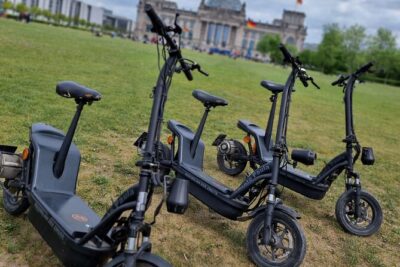
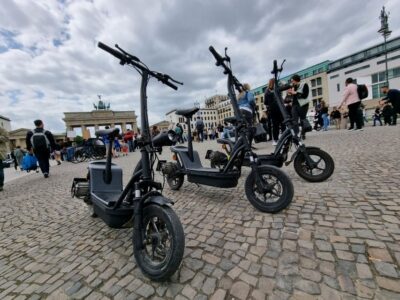
Berlin: 3-H VIP Private E-Scooter Highlights Tour
Read our review →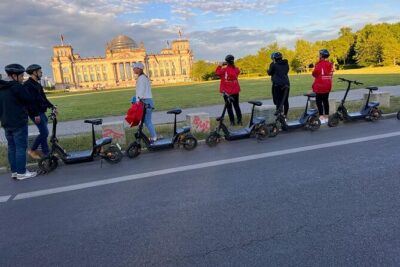
Other lists with this scooter ride