

Review · ATHENS
Athens by Night Electric ATV Scooter Tour
Athens changes character after sunset. On this three-hour electric ATV scooter tour, you roll through Plaka, pause below the Acropolis, climb the hills where ancient Athenians debated power and justice, and watch the city lights gather around the old stones. It is a lively way to connect Athens’ 3,000 years of history without spending the whole evening on foot.
I like the small group of no more than 10 people, which should make it easier to hear the guide and stop for photos. I also like the quiet electric scooters and the broad route, which links the Acropolis, Ancient Agora, Syntagma Square, the Panathenaic Stadium, and the Roman monuments in one outing.
The main thing to consider is the scooter itself. You need to feel comfortable handling a small four-wheel vehicle, and the tour is not suitable for children under 9. Helmets are optional, insurance is included, and the ride takes place outdoors, so weather and your own comfort on a scooter matter.
Key points to know before you book

- A three-hour route covers Athens’ major historic districts, including Plaka, Thissio, Monastiraki, Syntagma, and the area around the Panathenaic Stadium.
- The electric ATV scooter gives you more range than a walking tour, while keeping the ride quieter and free from fuel fumes.
- The Areopagus and Pnyx provide the best historical viewpoint stops, with sweeping views toward the Acropolis and central Athens.
- Stelios has been especially patient with first-time riders, making this a useful option if you need a little time to learn the four-wheel scooter.
- The tour is limited to 10 participants, so you get a more personal experience than on a large coach or crowded group walk.
- The $100 price is strongest for people who value transport, guiding, and several neighborhoods in one evening, but entrance fees, food, drinks, and hotel transfers cost extra.
Why Athens works so well after dark

Athens can feel scattered when you first arrive. The Acropolis sits above the city, ancient ruins appear beside modern streets, and the historic center shifts from quiet lanes to busy squares in just a few minutes.
This tour helps you connect those pieces. You are not simply stopping at one famous monument. You are following the old core of Athens from Plaka toward the Acropolis, the civic spaces of classical Athens, the Roman remains, the modern parliament, and the stadium built for the first modern Olympic Games.
The evening setting adds a useful change of pace. Ancient stone theaters and temples look different under artificial light, while the hills offer a clear view of the city after sunset. You also avoid making every stop during the hottest part of the day, though summer evenings can still be warm.
The electric ATV scooters are small, and the route is designed for city sightseeing rather than speed. You get the fun of riding without the noise of a gas-powered vehicle. That matters in narrow historic streets, where a loud engine would work against the mood.
More Night Scooter Tours in Athens:
- Vespa Sidecar Tour By Night with Pickup
★ 5.0 · 1,803 reviews - Saigon Evening Food Tour by Scooter
★ 5.0 · 944 reviews - Bangkok: E-Scooter Night Tour with Local Street Food
★ 4.8 · 488 reviews
Starting in Plaka, Athens’ oldest quarter
The ride begins in Plaka, the oldest and most picturesque district in Athens. This is a sensible starting point because you are already close to the Acropolis, the Roman Agora, and several old streets that lead toward the main archaeological areas.
Plaka is known for its traditional Greek atmosphere, and the tour uses it both at the start and near the end. The return through the neighborhood gives you a second look after you have learned how it fits into the city’s older street plan.
You should not expect a long walking visit through every lane. The point here is to ride through the district and pause at useful places. The scooter lets you cover more ground, but you still get brief stops for historical explanations, photographs, and rest.
If you are new to a four-wheel scooter, allow yourself a little time to get used to it. One guide, Stelios, has been praised for being patient while a rider learned the controls. That detail is useful: you do not need to arrive as an experienced ATV rider, but you should be willing to listen carefully and take the first part slowly.
The Acropolis and the Odeon of Herodes Atticus
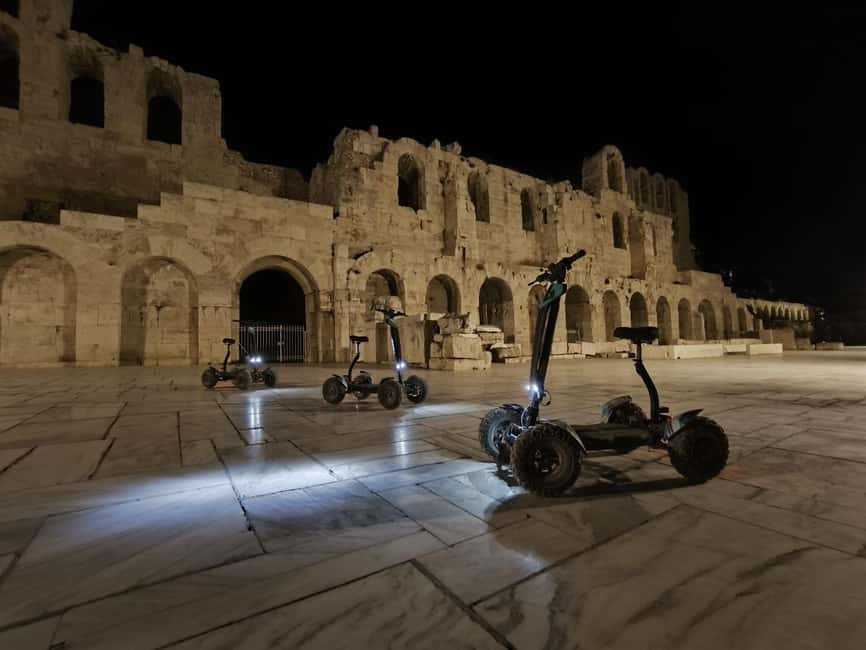
The first major part of the route brings you alongside the Acropolis. The famous hill dominates Athens, and an evening view gives you a different feel from a daytime visit inside the archaeological site.
The tour focuses on viewpoints and landmarks rather than an Acropolis entry. Entrance fees are not included, so do not book this experience expecting a guided visit through the Parthenon complex. Instead, you get the chance to look up at the illuminated rock and understand how it controls the shape of the city around it.
The route also reaches the Odeon of Herodes Atticus, the ancient stone theater beneath the Acropolis. It is one of the most striking monuments in this part of Athens, with steep seating and a setting that still connects the old city to performance and public life.
You will have time for photographs and an explanation of the theater’s place in Athens. The stop should appeal to anyone who wants more than a quick photo of the Acropolis itself. It adds a sense of scale, showing how the ancient city used the slopes below the sacred hill.
Areopagus and Pnyx, two hills with big ideas

The Hill of Mars, also called the Areopagus, is one of the tour’s best stops for understanding Athens from above. Ancient judicial proceedings took place here, and the position gives you a clear view toward the Acropolis and the city below.
The hill is also a practical orientation point. After seeing Athens from this height, the streets and districts you pass on the scooter make more sense. You can see how the old center sits between the Acropolis and the surrounding hills.
The Pnyx offers a different kind of history. It is linked with the birth of democracy, since ancient Athenian citizens gathered there to discuss and decide political matters. The stop gives the tour a strong human story: Athens was not only a city of temples, but also a place where public debate shaped government.
These hills are likely to be more rewarding for you if the guide takes time to explain the setting rather than rushing through it. The views are excellent for photos, but the real value is the connection between the physical place and the ideas associated with it.
More quad bike runs around Athens:
- Ancient Athens Electric ATV Scooter Tour
★ 4.9 · 29 reviews - Best of Athens Electric ATV Scooter Tour
★ 4.3 · 5 reviews - Modern Athens Electric ATV Scooter Tour
★ 5.0 · 4 reviews - Scooter rentals ,Atv rentals and Buggy Rental,Nassau Bahamas
★ 5.0 · 40 reviews
Thissio, Keramikos, and the Ancient Agora
The ride continues through Thissio, a pleasant historic area close to the Acropolis and the old civic center. From there, you approach the Keramikos Archaeological Site, which combines two sides of ancient Athenian life: pottery production and burial grounds.
Keramikos is not just another pile of ruins. It helps explain how the city worked beyond its famous temples. Craftspeople made pottery here, while the cemetery reflects customs, social divisions, and daily life in the classical period.
The Ancient Agora then brings you to the old heart of public Athens. This was where people met, traded, handled civic business, and took part in the daily life of the city. Seeing it after hearing about the Pnyx and Areopagus gives you a better sense of how democracy, courts, markets, and public debate fit together.
The tour does not include archaeological-site entrance fees. You will see the areas from the route and receive information at stops, but you should plan a separate visit if you want to enter Keramikos or the Ancient Agora and explore them in detail.
Monastiraki and the Roman layer of Athens

Monastiraki Square brings you back into present-day Athens. The area mixes old buildings, shops, restaurants, and constant city movement, making it a good contrast with the quieter hills and archaeological sites.
The scooter is useful here because you can connect several nearby landmarks without repeatedly retracing your steps on foot. Still, this is a city tour, not a closed-road ride. You should pay attention to the guide and remain comfortable with the vehicle in an active urban setting.
Nearby, the route passes the Library of Hadrian and the Roman Agora. These sites show how Athens changed after the classical period, when Roman power reshaped parts of the city. The Library of Hadrian was a major cultural complex, while the Roman Agora served practical civic functions.
This section gives the evening a useful historical rhythm. You see the classical city, then the Roman additions, then modern Athens. A guide can make those layers easier to follow than a string of disconnected monument stops.
Syntagma Square and the changing of the guards
At Syntagma Square, the tour reaches the political center of modern Greece. The Hellenic Parliament faces the square, and the changing of the guards connects today’s state with older Greek military and ceremonial traditions.
The timing matters here. The tour promises a chance to witness the changing of the guards, but the exact ceremony you see depends on the schedule and the tour’s timing. Ask the provider for the start time if this is one of your main reasons for booking.
Syntagma is a useful contrast to the ancient sites. You are no longer looking at the remains of a past government. You are seeing the working center of the modern Greek state, surrounded by a major city square.
The tour then continues past the National Gardens and Zappeio Mansion. These landmarks add a more formal, 19th-century side of Athens to the route. The gardens offer a change from stone and traffic, while the mansion reflects the city’s modern public architecture.
Panathenaic Stadium and the final Roman monuments
The Panathenaic Stadium is one of the most memorable stops on the route. Built entirely of marble, it hosted the first modern Olympic Games in 1896. Its long, curved seating and bright stone make it easy to recognize, even from outside.
This stop links ancient athletic traditions with the modern Olympic movement. You get a strong photo opportunity, but you also get a clear example of how modern Athens used its ancient past when presenting itself to the world.
The final historic stops are Hadrian’s Arch and the Temple of Olympian Zeus. Hadrian’s Arch marks the connection between the older Greek city and the Roman period. The Temple of Olympian Zeus, with its huge surviving columns, gives you a sense of the scale Roman-era building projects could reach.
Ending near these monuments is a fitting way to close the historical route. You have moved from democracy and theater to Roman architecture, modern government, and international sport, all within a compact section of Athens.
What the $100 price includes
At $100 per person, this is not the cheapest way to see central Athens. The value comes from combining a vehicle, an English-speaking tour leader, insurance, historical commentary, and a three-hour route that would require a lot of walking to cover on your own.
The small group limit of 10 improves the value. You are less likely to get lost in a large crowd, and it should be easier to ask questions or hear the guide at each stop. You also get a more active experience than a standard sightseeing bus.
The price does not include hotel pickup or drop-off, entrance fees, food, or drinks. You need to reach the starting point in Plaka yourself and budget separately if you want to go inside the Acropolis, Ancient Agora, Keramikos, or another archaeological site.
I would choose this tour if you want orientation and many exterior views in one evening. I would not choose it as a substitute for a full archaeological tour. It is best paired with separate daytime visits to the monuments you most want to enter.
Who will enjoy the scooter ride most
This experience suits you if you like seeing a city actively and want more range than a walking tour provides. It is also a good early-in-your-stay activity because the route helps you understand where the main neighborhoods and monuments sit in relation to one another.
The experience may work well for older travelers who want to avoid a long walking circuit. The scooter reduces the distance between stops, and the itinerary includes brief rest and hydration breaks. Still, you need to be comfortable getting on, steering, and operating the four-wheel scooter.
Children under 9 cannot join. The small group format may appeal to couples, friends, and families with older children who want a shared activity rather than a long lecture.
You should bring comfortable shoes and a small bottle of water. In hot weather, use sunscreen on exposed skin and consider lightweight sunglasses. In cooler seasons, add a layer, and gloves or a scarf may help. If rain threatens, a plastic poncho can be provided.
Booking advice and final verdict
Free cancellation is available up to 24 hours before the tour for a full refund, and you can reserve now and pay later. Those terms are useful when your Athens schedule depends on weather or changing arrival plans.
I recommend the Athens by Night Electric ATV Scooter Tour if you want a guided city overview with a bit of fun built in. It is particularly appealing if you are curious about Athens’ history but do not want to spend three hours walking from monument to monument.
Book it early in your stay if you want help getting your bearings. Choose another experience if your top priority is entering the archaeological sites, spending long quiet periods at each monument, or avoiding vehicles altogether.
The strongest reason to book is the combination of range and personal attention. With a group capped at 10 and a patient guide such as Stelios, you get a lively introduction to Athens that connects ancient hills, Roman ruins, modern government, and Olympic history in one evening.
FAQ
How long is the Athens by Night Electric ATV Scooter Tour?
The tour lasts three hours.
Where does the tour begin?
The tour begins in the Plaka neighborhood of Athens.
What language is the tour conducted in?
The live tour guide speaks English.
How many people can join the tour?
The group is limited to 10 participants.
Is the electric ATV scooter included?
Yes. A small ATV scooter is included in the tour price.
Are helmets provided?
Yes. Helmets are provided, and they are listed as optional.
Is insurance included?
Yes. Insurance is included.
Are entrance fees included?
No. Entrance fees are not included in the tour price.
Is hotel pickup and drop-off included?
No. You must arrange your own transportation to and from the starting point.
Can children join the tour?
Children under 9 years old cannot join the tour.
What should I bring?
Bring comfortable shoes and a small bottle of water. A hat, sunscreen, and lightweight sunglasses are useful in hot weather. In cooler seasons, bring an extra layer, and consider gloves and a scarf.
Freshly added rides around Athens
- GoPro Adventure Tour in Acropolis area by E-Scooter★ 4.5 · 8 reviews
- 10 Days Tour Walk Athens Cycle Peloponnese Scooter Santorini★ 5.0 · 4 reviews
- Modern Athens Electric ATV Scooter Tour★ 5.0 · 4 reviews
- GoPro Adventure Tour in Acropolis area by E-Scooter★ 4.9 · 19 reviews
- Best of Athens Electric ATV Scooter Tour★ 4.3 · 5 reviews
- Athens: Guided City Tour on an Electric Trikke Scooter★ 4.4 · 7 reviews
- Ancient Athens Electric ATV Scooter Tour★ 4.9 · 29 reviews
- Athens: Premium Guided E-Scooter Tour in Acropolis Area★ 5.0 · 133 reviews
Athens Scooter Tours, compared.

Athens: Award-Winning Acropolis Guided e-Scooter Tour
Read our review →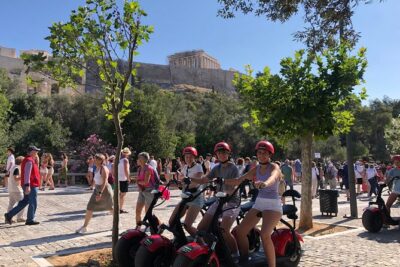
Athens Acropolis Official E-Scooter Guided Tour Fat E-Bike
Read our review →

Athens: Premium Guided E-Scooter Tour in Acropolis Area
Read our review →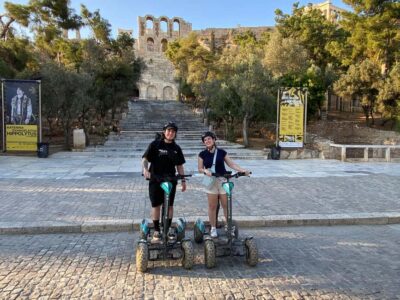
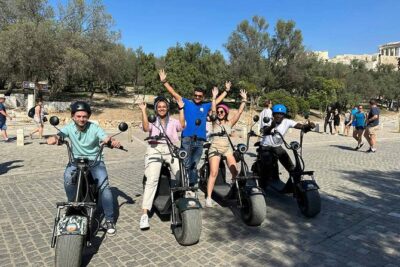
GoPro Adventure Tour in Acropolis area by E-Scooter
Read our review →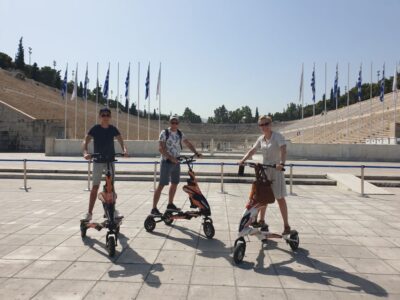
Athens: Guided City Tour on an Electric Trikke Scooter
Read our review →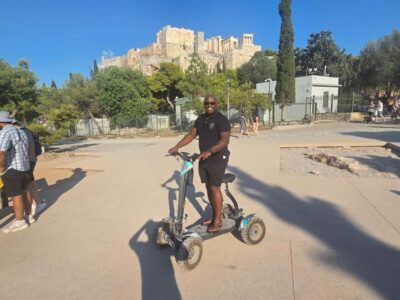
Other lists with this scooter ride